Case study 03 / 07 · Studio website
← All workiVyn Labs


The work, seen through glass.
The website of iVyn Labs, the web, product and AI studio I co-founded. The studio's real work is refracted through reeded glass in WebGL, and clears into the actual products as you scroll.
- Role
- Co-founder & engineering lead: design, engineering and motion
- Year
- 2026
01Overview
Overview
Built with
- Next.js 16
- React 19
- TypeScript
- Tailwind CSS 4
- WebGL2 & GLSL
- GSAP & ScrollTrigger
- Lenis
- View Transitions API
Filed under
- iVyn Labs
- Website
- WebGL
- Motion
02The challenge
The challenge
A new two-partner studio needed a site that proves itself in the first two screens without inventing anything: no testimonials, client logos or studio metrics exist yet. It also had to look nothing like this portfolio, while holding up to the same motion, performance and mobile standard.
03The thinking
Roads taken, and the ones that weren’t.
- 01
Took
The work's own captures, refracted through glass, as the only colour on the site.
Instead of
A brand accent colour or decorative gradients.
Because
Visitors see real shipped products from the first second, and the interface never competes with the work.
- 02
Took
Native View Transitions for page changes.
Instead of
A full-screen panel that covers the page before revealing the next one.
Because
Pages hand over directly with no blank screen, and the browser composites the motion, so it stays smooth on phones.
- 03
Took
Inset the hero's frame with a clip path.
Instead of
Animating the frame's size as the glass clears.
Because
Resizing a WebGL canvas wipes it for a frame; clipping keeps the picture intact, so the hero never flickers.
04The engineering
The system, taken apart.
Content is typed data; pages, share images and discovery files are generated from it at build time. Motion runs on the client in three layers: a WebGL2 field for the hero, GSAP and ScrollTrigger for scroll choreography, and the browser's View Transitions for page changes.
01
Content
- Typed projects & services
- Studio facts & partners
- Real project captures
02
Build
- Next.js App Router pages
- OG images & JSON-LD
- Sitemap & llms.txt
03
Motion
- WebGL2 reeded-glass field
- GSAP ScrollTrigger & Lenis
- View Transitions
04
Fallbacks
- CSS glass without WebGL2
- Reduced-motion finished states
- Plain navigation
The loopScroll drives the glass: the hero's scroll progress feeds the shader every frame without React renders, so the field clears in step with the page
What was built
- 01
A WebGL2 shader refracts project captures through fluted glass in the hero. Scrolling straightens the flutes and brings the captured sites into focus.
- 02
Capped the field's luminance inside the shader so white headlines keep their contrast over any capture, bright or dark, while the hue survives.
- 03
Load the phone captures on tall screens, so on a phone the cleared hero is a real mobile screen rather than a crop of a desktop one.
- 04
Moved route changes onto the View Transitions API: the page you leave recedes into the night as the next one rises over it, and project images fly into the case-study cover as shared elements.
- 05
Rendered every page, its metadata, JSON-LD, sitemap and llms.txt from one typed content source, so the studio's facts are stated once.
- 06
Gave every motion a reduced-motion path: the hero holds a clear capture, loops stop, and route changes become plain navigation.
05The experience
What people actually see.
Captured from the live product. Nothing here is a mock-up.


06What shipped
What shipped
- A hero that turns abstract colour into real shipped work in one scroll.
- Page changes that hand over directly, with no blank frame between pages.
- Every page, share image, JSON-LD and llms.txt generated from authored content.
Next case study
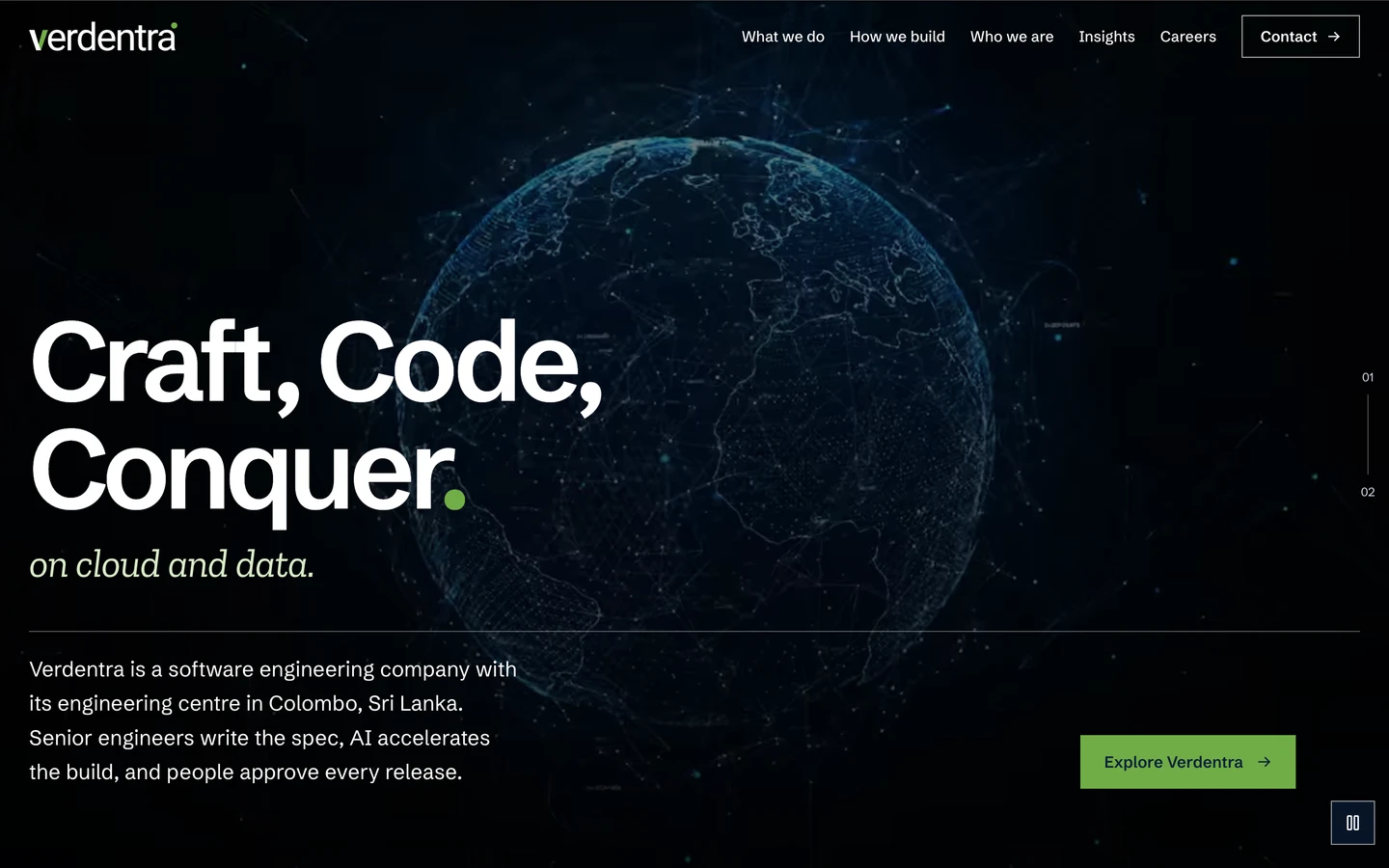
Verdentra
A new public home for Verdentra’s engineering work.
Continue